Free studio tool · potential-client research
Find potential clients whose needs fit your work
Check one potential client for portfolio fit, dated public evidence and contact rules. Choose your next step—contact, research further or park—and make a note you can reuse. Try it below or use the free three-page printable checklist.
Printable A4 PDF · 3 pages · No signup needed. Print at actual size on A4, or choose “Fit” on US Letter. This is a self-directed research sheet, not a supplied lead list; it does not guarantee sales.
Read the fictional example ↓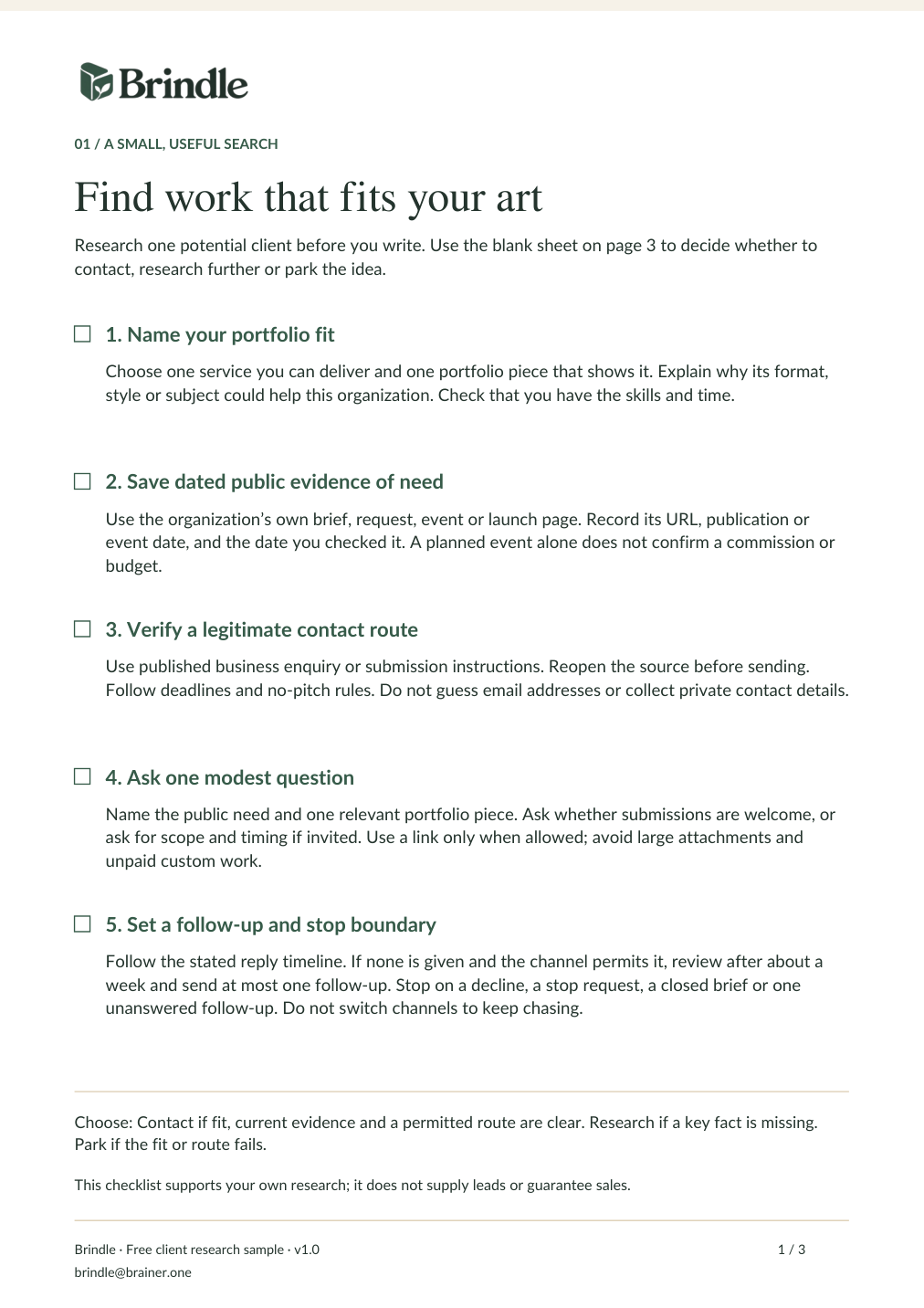
Optional browser companion · one candidate
Check one potential client in your browser
Start with a candidate you found. Separate what the public source says from what you still need to learn. You choose the next step; a good fit alone does not mean work is available.
Your entries stay in this page’s browser memory. Nothing is sent, saved or transferred to an account. Reloading or leaving clears them. Copy only writes your note to your device’s clipboard; Clear does not erase the clipboard. Supplied URLs remain plain text and are not opened or looked up.
This is a research record, not a message sent to the candidate. Check the source, facts, unknowns and published rules before acting. Edit any part below.
Page 1 · five checks
Research one candidate, not a long list.
A clear fit is more useful than another name in a spreadsheet. Choose whether to contact, research further or park the idea.
- Name your portfolio fit. Choose one service and one portfolio piece. Explain how its format, style or subject could help. Check your skills and available time.
- Save dated public evidence. Record the organization’s own brief, request, event or launch page, its URL, publication or event date, and your check date. An event alone does not confirm a commission or budget.
- Verify a public contact route. Recheck published enquiry or submission instructions before sending. Respect deadlines and no-pitch rules. Do not guess addresses or collect private contact details.
- Choose a permitted next step. If enquiries are allowed, name the public need and one relevant piece, then ask one small question about scope or timing. If permission is unclear, research first. If pitches are prohibited, do not pitch. Use links only when allowed; avoid large attachments and unpaid custom work.
- Set a stop boundary. Follow the stated timeline. If none is given and follow-up is permitted, review after about a week and send at most one follow-up. Stop on a decline, stop request, closed brief or unanswered follow-up. Do not chase on another channel.
Page 2 · fictional worked example
An illustrator’s first enquiry
Mina Vale, Lantern Field Press, the portfolio piece, source labels and all details below are invented. These are not real leads, URLs or contacts.
Portfolio fit
Mina offers botanical cover illustration and has room for one cover. Her invented “Wild Seed” piece shows plant drawing with space for a book title. That format may suit a nature publisher.
Dated evidence
Source A is an invented publisher brief dated 12 November 2026. It invites one relevant portfolio link for a spring field-guide cover. Mina checked it on 19 November; it closes on 26 November 2026.
Fact, then unknowns
The brief invites submissions in this scenario. Fee, usage rights, exact scope and delivery date are still unknown. A submission is not a commission.
Route and decision
Source B is an invented submissions form that accepts one portfolio link and says not to follow up. Mina rechecks both sources. Decision: contact through the form, then wait; no follow-up.
A modest first message
Hello Lantern Field Press team, I saw your field-guide cover brief. I make botanical cover illustrations; my “Wild Seed” piece may fit: [one portfolio link]. Could you share the artwork scope, usage rights and delivery date? Thank you, Mina.
Mina records the submission date. The form says no follow-up, so she sends none. Silence is not permission to chase through another channel.
Three choices, one clear next action.
Reusable alternatives in Mina’s invented scenario. Choose your own decision; these do not establish a real lead or available work.
Research further
Recheck invented Source A and Source B on 19 November 2026 for scope and submission permission. If either remains unclear, keep researching or park; do not send a pitch to find out when pitches are prohibited.
Park
Record “not proceeding now” on 19 November 2026. Do not contact or follow up. Review only if a new public brief invites work that fits Mina’s service and capacity.
Page 3 · your blank sheet
Make it your own, on paper.
Print another copy of page 3 for each candidate. The PDF is printable, not an interactive fillable form.
Download the blank sheet + example ↓- Write the organization and your check date. Record public business information only.
- Add your service, portfolio piece and reason for fit. Save the exact need, source URL and publication or event date.
- Record the published route, deadline and no-pitch rules. List unknowns separately from evidence.
- Draft one small question. Choose contact, research or park, and write your next action.
- Record when you sent it, any permitted review date and the stop rule. Keep your sheet where you choose; Brindle does not receive your entries.
Make room for the next client action.
Money still owed and bills ahead can help you choose what needs attention. Try the free studio money-review sample →
A fictional received/paid/unpaid/upcoming review, two dated actions and a reusable blank sheet. Two-page printable PDF, no signup needed.
Want a private place to return to your research?
The optional private browser app saves the client research and dated actions you enter manually. This free companion does not transfer its inputs or note.
Start an optional private client shortlist →An account is needed to save privately. Creating one does not start a payment.
Optional · two questions
Which business task feels harder?
Help us understand what solo creatives need. You can use every free sample without answering.
Unsent answers stay in this page’s temporary browser memory. They are not sent to Brindle or saved in cookies, browser storage or our database. Clear them below; reloading or leaving this page resets them.
Only if you choose to open your email app will the draft pass to that app. You decide whether to send it. If you send it, we receive your answers, email address and any signature you include, to review feedback. Please leave out financial figures, client details and other sensitive information. Privacy details →
A next step for the business behind your work.
Pair your client research with the free income-and-costs worksheet, or check project assumptions with the free project-price calculator.
Explore the complete money & client workbook → This free checklist is separate from the paid workbook and its three-page preview.
Have a question or feedback? Email brindle@brainer.one.