
Your month, on paper.
Use this free income-and-costs worksheet to see what came in, what went out, and what needs your attention next.
Two pages: a blank sheet and a fictional worked example. A4 PDF, also printable on US Letter with “Fit to page.” No account or email needed.
Need to include money still owed and bills ahead? Try the unpaid-money & upcoming-bills review below ↓ Or open the focused studio money review →.
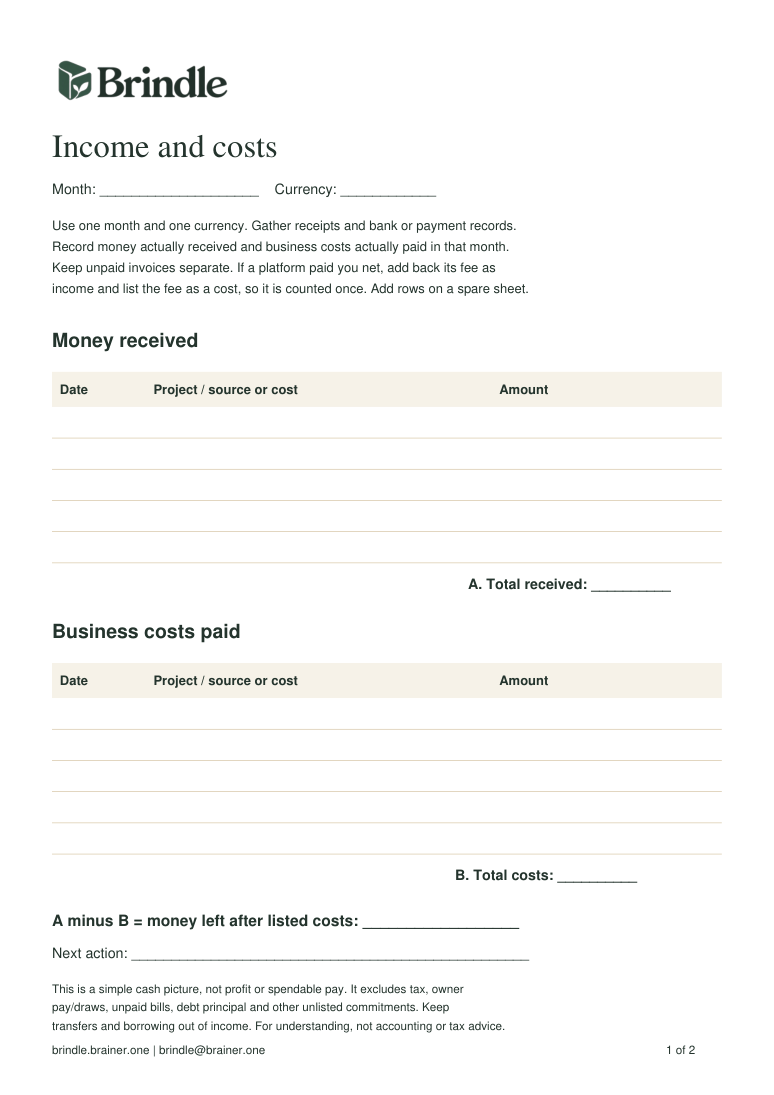
Income and costs
Month: ____________________ Currency: __________
Record money actually received and business costs actually paid during the same month, in one currency. Keep unpaid invoices separate. If a platform paid you net, add back its fee as income and list the fee once as a cost.
Money received
| Date | Project / source or cost | Amount |
|---|---|---|
Total: ____________________
Business costs paid
| Date | Project / source or cost | Amount |
|---|---|---|
Total: ____________________
Total received − total costs = money left after listed costs: __________
Next action: ___________________________________________________
How to use the sheet
- Choose one month and one currency. Gather your receipts, bank records and payment records.
- List money you actually received that month. Leave unpaid invoices out of this total.
- List business costs you actually paid that month. If a platform deducted a fee, record the income before the fee and the fee as a cost, once.
- Add each list. Subtract total costs from total received. Keep transfers and borrowed money out of income.
- Check what the difference leaves out. Choose one next action, such as following up on an unpaid invoice or reviewing next month’s bills.
Add rows on a spare sheet if you need more space. This is a simple cash picture, not take-home pay or accounting profit. Tax, owner pay/draws, unpaid bills, debt principal and other commitments still need checking. Financial material helps you understand your business; it is not professional accounting or tax advice.
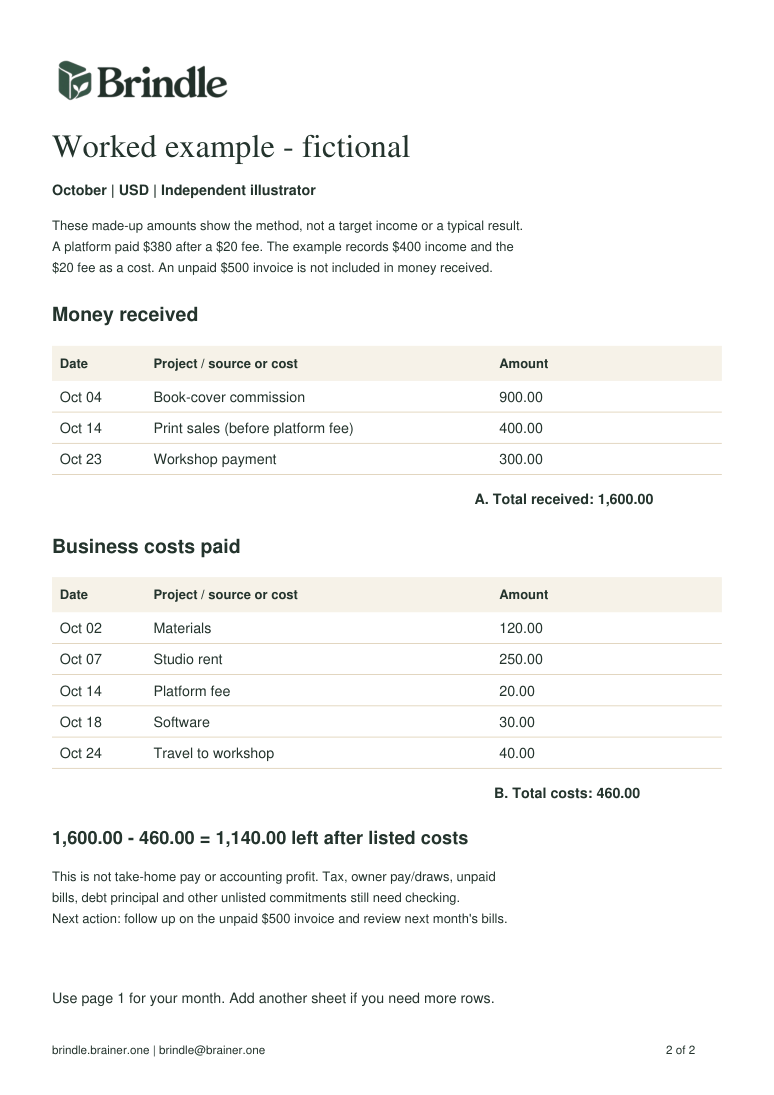
Worked example
Fictional illustrator · October · USD. These amounts show the method, not typical earnings or a target.
| Money received | |
|---|---|
| Book-cover commission | 900.00 |
| Print sales, before fee | 400.00 |
| Workshop payment | 300.00 |
| Total received | 1,600.00 |
| Business costs paid | |
| Materials | 120.00 |
| Studio rent | 250.00 |
| Platform fee | 20.00 |
| Software | 30.00 |
| Travel | 40.00 |
| Total costs | 460.00 |
1,600 − 460 = 1,140 USD
left after listed costs
The platform sent 380 USD after a 20 USD fee. This example records 400 USD income and the 20 USD fee as a cost. An unpaid 500 USD invoice is excluded.
Next action: follow up on that unpaid invoice and review next month’s bills. The 1,140 USD is not take-home pay; it excludes the commitments noted above.
Inside the income-and-costs PDF
Free studio money review · browser or paper
See what arrived, what is owed and what is coming due
See what arrived, what you paid and what still needs attention. Try the review here, then choose one dated money action and one small client-research action. Rowan’s worked example and the free printable are below.
Free printable A4 PDF · 2 pages · No signup needed. Print at actual size on A4, or choose “Fit” on US Letter. Printable, not an interactive fillable form. The cash difference is not a bank balance or spendable pay. This sheet is for understanding your business, not accounting or tax advice.
Optional browser companion · no signup needed
Make a studio money review here
Gather your payment records, invoices and bills. Add up each category yourself, then enter its total below. Use one currency, one review period and a review date. Keep currencies in separate reviews; do not add unlike currencies together. Received and paid cover the same period; unpaid and upcoming describe what is still open at your review date.
Entries stay only in this open page’s memory. Nothing is sent or saved. Nothing transfers to or from your private saved review. Reloading or leaving clears them. Copy writes only the note to your device’s clipboard; Clear does not erase the clipboard.
Check the period, currency, amounts and both action dates before copying. Editing this note does not change the totals. Edit below, then copy it somewhere you choose to keep. Nothing is sent by Brindle.
Rowan’s month, in four separate lists
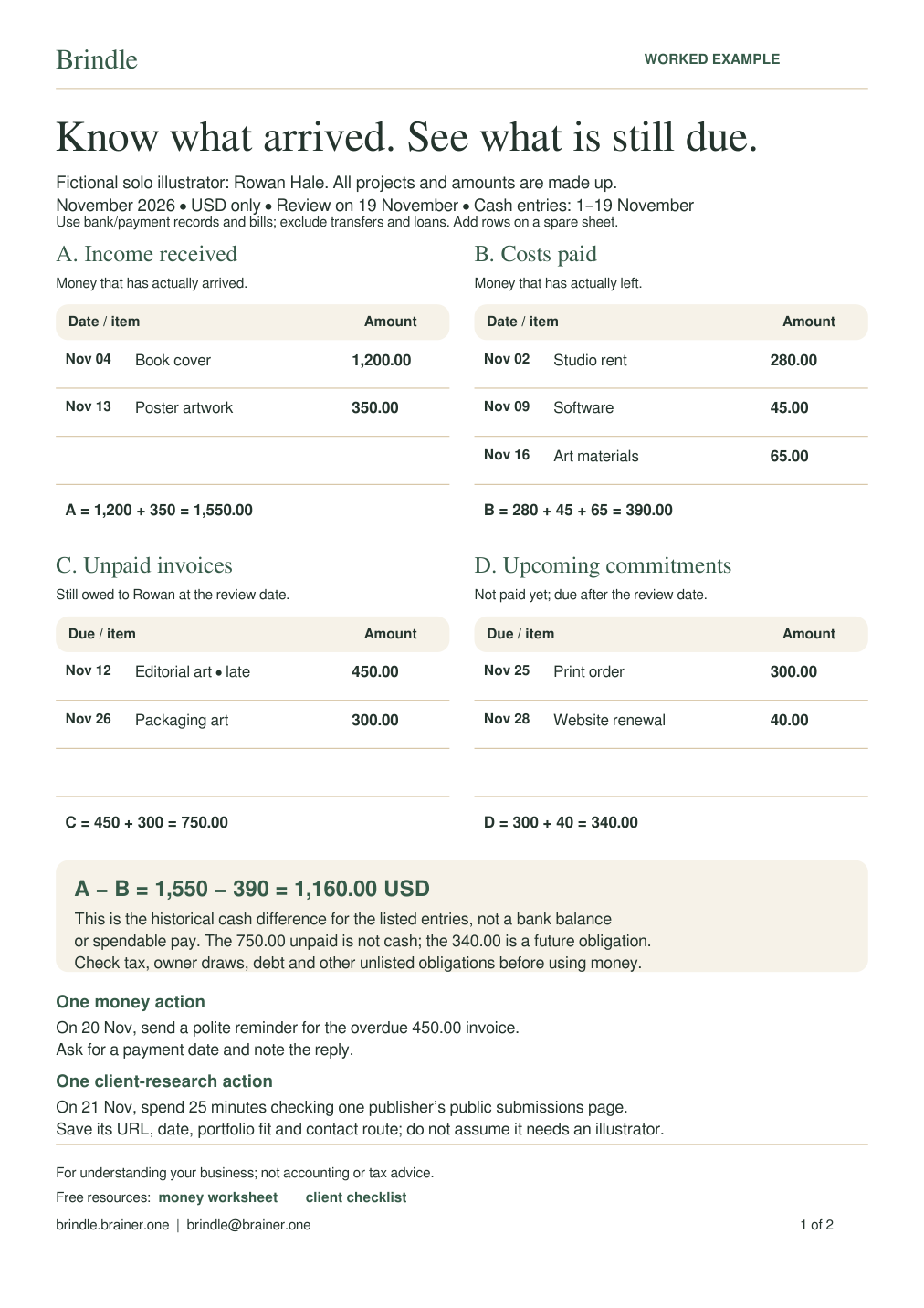
Rowan Hale is a fictional solo illustrator. All projects and amounts are invented, not typical earnings or a target. November 2026 · USD only · reviewed on 19 November · cash entries from 1–19 November.
Income received
Money that has actually arrived.
| Date / item | USD |
|---|---|
| Nov 04 · Book cover | 1,200.00 |
| Nov 13 · Poster artwork | 350.00 |
| Total | 1,550.00 |
Costs paid
Money that has actually left.
| Date / item | USD |
|---|---|
| Nov 02 · Studio rent | 280.00 |
| Nov 09 · Software | 45.00 |
| Nov 16 · Art materials | 65.00 |
| Total | 390.00 |
Unpaid invoices
Still owed at the review date; not received income.
| Date / item | USD |
|---|---|
| Due Nov 12 · Editorial art · overdue | 450.00 |
| Due Nov 26 · Packaging art | 300.00 |
| Total | 750.00 |
Upcoming commitments
Not paid yet; due after the review date.
| Date / item | USD |
|---|---|
| Due Nov 25 · Print order | 300.00 |
| Due Nov 28 · Website renewal | 40.00 |
| Total | 340.00 |
1,550 − 390 = 1,160 USD
Historical cash difference for the listed entries.
The 750 USD unpaid is not cash. The 340 USD is a future obligation. Neither is included in received minus paid. Check actual funds, tax, owner draws, debt and other unlisted obligations before using money.
One money action
On 20 November, send a polite reminder for the overdue 450 USD invoice. Ask for a payment date and note the reply.
Adapt a free invoice reminder →One client-research action
On 21 November, spend 25 minutes checking one publisher’s public submissions page. Save its URL, date, portfolio fit and contact route. Do not assume it needs an illustrator.
Use the free client-research checklist →Make the next review your own, on paper.
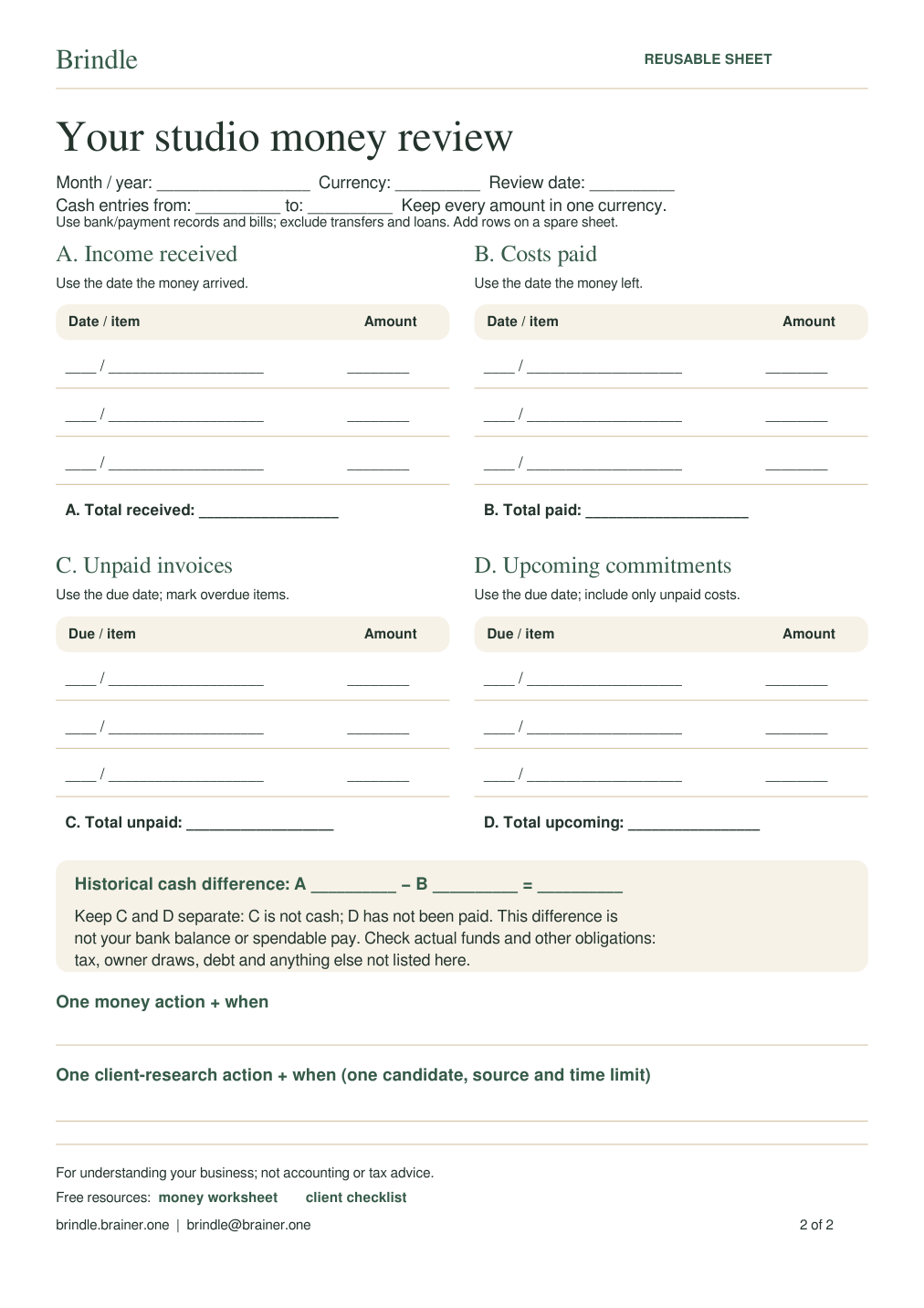
Use page 2 for your own month, currency and review date. Gather payment records and bills. Exclude transfers and loans, mark overdue invoices, and add rows on a spare sheet if needed. Keep four separate totals, then write two dated actions.
This is a separate printable sample, not an app screen. Nothing is transferred to or from your saved review; your worksheet entries stay wherever you keep the sheet.
Have a question or feedback? Email brindle@brainer.one.
Planning a new project? Try the free project-price calculator →
See how costs, hours and desired hourly pay add up. Financial inputs stay in your browser and are not saved.
Looking for work that fits your portfolio? Try the free potential-client checklist →
Five research checks, a fictional example and a blank sheet. No account or email needed.
Want to connect your monthly review with your client search? Explore the workbook contents →